Wilhelm von Gloeden
 born 16 September 1856 (d. 1931)
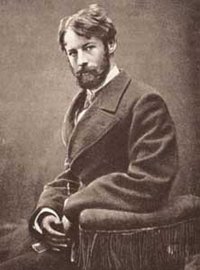
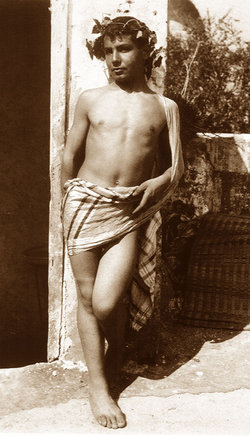
Baron Wilhelm von Gloeden was a German photographer who worked mainly in Italy. He is mostly known for his pastoral nude studies of Sicilian boys, which usually featured props such as wreaths or amphoras, suggesting a setting in the Greece or Italy of antiquity. From a modern standpoint, his work is commendable due to his controlled use of lighting as well as the often elegant poses of his models. Innovative use of photographic filters and special body make-up contribute to the artistic perfection of his works.
Von Gloeden was a minor German aristocrat from Mecklenburg who, suffering from what appears to have been tuberculosis, came to Taormina in Sicily in 1876. He was wealthy and provided a considerable economic boost in this comparatively poor region of Italy, which might explain why the homosexual aspects of his life and work were generally tolerated by the locals.
Von Gloeden, who in the 1880s had started photographing boys, but had also made portrait studies of local peasants and engaged in some landscape photography, turned his hobby into a profitable business in the 1890s when his family fell on hard times financially. Already a local celebrity in Taormina, his work (and his models) drew to Sicily such luminaries of the times as
Oscar Wilde, the 'cannon king' Alfred Krupp, Richard Strauss
, as well as the German Kaiser.
The bulk of von Gloeden's work stems from this time period up until the beginning of World War I. His idyllic 'illustrations of Homer and Theocritus', i.e. pictures of skimpily clad boys in classical poses, were also reproduced as postcards and enjoyed popularity as souvenirs for tourists.
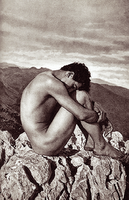
Von Gloeden generally made different kinds of photographs: the ones that garnered the most widespread attention in Europe and overseas were usually relatively chaste, featured clothes such as togas and generally downplayed their homoerotic implications.

More explicit photos in which the boys were nude and which, because of eye contact or physical contact were more sexually suggestive were traded by the Baron 'under the counter' to close friends.
Still, considering the prudish and homophobic atmosphere of the time, it is remarkable that von Gloeden and large parts of his work were generally accepted and respected. The popularity of his work in Germany, England, and America can possibly be attributed to four major reasons:
- He was a consummate and talented photographer.
- The Classical and painterly themes in which his work wreathed itself served as a cultural 'badge of protection'.
- At that time male-male-love 'did not speak its name' and was thus totally unthinkable to many who saw his images.
- New printing technologies enabled the mass reproduction and sale of his work in postcard form.

In total the Baron took over 3,000 images, which after his death were left to one of his models, Pancrazio Bucini, also known as Il Moro for his North African looks. In 1936, over 2,500 of the pictures were destroyed by Mussolini's police under the allegation that they constituted pornography. Most of the surviving images therefore come from private collections.
 George Chakiris born 16 September 1934