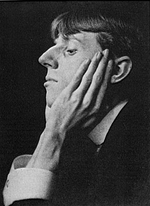
 Aubrey Beardsley born 21 August 1872 (d 1898)
Born in Brighton to a genteel but nearly destitute family, Aubrey Beardsley was a musical and artistic prodigy as a child who went on in his short life to become a highly original and influential illustrator, one of the greatest of the Symbolists.
He was educated at the Bristol Grammar School and later, with the encouragement of Pre-Raphaelite painter Sir Edward Burne-Jones, attended night classes at the Westminster School of Art. Although he absorbed a number of influences, including that of the Pre-Raphaelites, Beardsley was largely self-taught.
In 1892, the young artist received his first commission, an invitation to illustrate an edition of Thomas Malory's Morte D'arthur for the publisher J M Dent. The assignment entailed over 300 illustrations and chapter heads, which the artist executed in a mock-medieval, Pre-Raphaelite style.
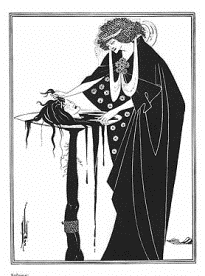 In 1893, as he was working on the Dent commission, he met Oscar Wilde, with whom he would be associated for the rest of his life, at least in the public's imagination. Beardsley was invited by Wilde's publisher to illustrate the English edition of Salome. When it was published in 1894, both the play and the witty, provocative - blatantly erotic - illustrations created a sensation.
That same year Beardsley became famous as the art editor of The Yellow Book, a new arts and letters periodical. Although Wilde never actually contributed to the magazine, it was widely assumed to be an organ for the aesthetic ideas that the playwright espoused. Beardsley's stunning black-and-white drawings, title-pages, and covers helped make the new quarterly a great success. But The Yellow Book also quickly became a site of the fin de siècle culture wars, a target of moralists concerned about the influence of the decadent movement on English society and art. One detractor described Beardsley's designs for the periodical as 'Diseased, weird, macabre, and sinister.'
 In the context of the growing notoriety of Wilde and his circle, this may be seen as an attack on the newly visible homosexual subculture that emerged at the end of the nineteenth century. The culture wars culminated in Wilde's prosecution and conviction for gross indecency in 1895. One casualty of the reaction triggered by the Wilde trials of 1895 was Beardsley himself. He was summarily fired from his job as art editor of The Yellow Book. He had been too closely associated with Wilde for the publisher's comfort and his art too erotic and perverse for the new mood of conformity prompted by Wilde's conviction.
Beardsley however continued to find work as an illustrator and created many more beautiful illustrations. Unfortunately, Beardsley had been plagued by ill-health and bouts of tuberculosis since childhood and he died in the South of France, where he had gone in search of a better climate for his increasingly frail health. He was just 25.
Considering the brevity of his life, Beardsley's achievement is astonishing. A highly original creator, he transformed the art of illustration and profoundly influenced artists of his own and subsequent generations.

